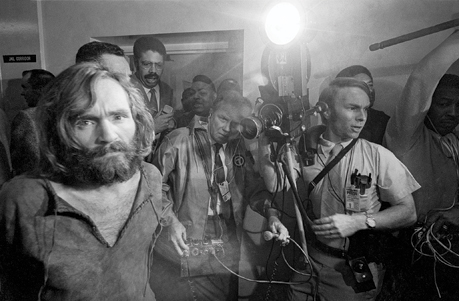
Jeff Guinn
There have been a lot of bad Charles Manson books, and one great one, written by Manson’s prosecutor: Vincent Bugliosi’s 1974 Helter Skelter, history’s top-selling true-crime book. It is probably the right time for another try, and Jeff Guinn’s new account adds to our image of the L.A. crime spree that sounded the death knell of the ’60s. For starters, by taking a biographical approach, it detaches Manson somewhat from that context, showing how the Depression and the Second World War helped in various ways to form him.
There are few surprises in Manson’s upbringing, detailed carefully here with family interviews for the first time. His single mother did some prison time early in his life and could not keep him out of juvenile reformatories practically designed to turn him into a con artist. This involved alternate helpings of prison rape and trendy self-help literature; Guinn documents Manson’s controversial, but relevant, participation in Scientology and Dale Carnegie seminars. Manson, it is important to remember, is not known to have killed anybody personally. His ability to impress and dominate people, refined by years of literally surviving on his wits, hit California like a weaponized bacillus.
Guinn’s version corrects the most important weakness of Helter Skelter by revealing just how close Manson and Beach Boy Dennis Wilson became. Bugliosi left music-industry people out of his book almost completely, but here, the Manson murders come off almost as an out-of-control end result of Charlie’s pursuit of a recording career. He came so close (Neil Young praised his guitar-improvisation skills) that one can almost imagine an alternative history in which the Charles Milles Manson of 2013 is a minor ’70s pop star and beloved hippie eccentric, instead of a wretched old murderer dying slowly in jail. Guinn’s Manson does not make for as good a book as Helter Skelter, but it might be a better primer for younger readers on one of the 20th century’s defining criminal cases.
APPLE TREE YARD
Louise Doughty
Yvonne Carmichael, the central character in Doughty’s gripping novel, is a married 52-year-old British geneticist on trial for murder alongside her lover, a man she doesn’t know half as well as she thinks she does. Recounted in first person, often through emails Yvonne writes at night to “Mr. X,” Apple Tree Yard traces how a woman who describes herself as possessing “status and gravitas” ends up in such an unlikely plight. More, it offers harrowing proof of how a series of bad decisions can easily amount to catastrophe. Yvonne is a familiar fiction trope—an educated, older woman able to describe herself wryly, if self-consciously, as wearing the sort of slightly showy boots “a middle-aged woman wears because they make her feel less like a middle-aged woman.” Married to a fellow scientist with whom she has two grown children, one of whom is bipolar, Yvonne has lived long enough to know success, experience sorrow and crave the sort of tantalizing promise offered by a furtive affair. “Sex with you is like being eaten by a wolf,” she writes to her lover, a man whose identity, the reader slowly learns, has been shaped by what Yvonne wants to believe. Still, she cleaves to her identity as a scientist seeking empirical knowledge: “DNA made me and DNA undid me. DNA is God,” she asserts. But as Doughty’s taut, sometimes shocking narrative plumbs the lower depths of betrayal, it’s apparent the truth is thornier. (An anecdote about a scientific experiment involving a mother chimp and her baby will haunt readers for days.) Doughty’s seventh novel is a unique hybrid—a riveting courtroom drama, an engaging exploration of ideas, and a harrowing exposé of human nature, or, as Yvonne puts it, “the stories we tell in order to make sense of ourselves, to ourselves.” The book is a triumph. Every page bristles with menace.
ROSEBUD SLEDS AND HORSES’ HEADS: 50 OF FILM’S MOST EVOCATIVE OBJECTS
Scott Jordan Harris
As whimsical as its title, this slim book of illustrated observations invites us to ponder the talismanic star power of mere things. They include props and costumes, guns and gadgets, but also more fanciful items, such as the white plastic bag that dances on a breeze in American Beauty and the prosthetic penis worn by Mark Wahlberg’s Dirk Diggler in Boogie Nights. Limiting his gallery to 50 items, British film critic Scott Jordan Harris makes no attempt to be comprehensive. When it comes to classic films, he ticks off the iconic landmarks, from the baby carriage on the steps in Battleship Potemkin to the ruby slippers in The Wizard of Oz. Though he resists ranking his inventory, superlatives abound. Dorothy’s slippers “are probably film’s most fetishized objects.” Citizen Kane’s Rosebud sled is “film’s most evocative object.” No dress is more famous than the white, windblown number worn by Marilyn Monroe above the sidewalk grate in The Seven Year Itch. And, “of all the guns in film, none is more infamous” than the .44 Magnum wielded by Clint Eastwood in Dirty Harry.
Some of the more contemporary picks seem arbitrary. Harris honours the Sherriff Woody doll voiced by Tom Hanks in Toy Story, but could just as well have picked Wilson, the volleyball that kept Hanks company in Cast Away. James Bond’s Golden Gun is honoured, yet his silver Aston Martin is absent from a fleet of conveyances that include the Batmobile, the Starship Enterprise, Kermit’s bicycle, Marty McFly’s hoverboard and the wheelchair in My Left Foot (the author notes he uses one himself). Yet a flair for idiosyncrasy is part of the book’s charm, along with its square, elegant design. Each object in Rosebud Sleds and Horses’ Heads gets a page of text opposite a bold graphic by one of three illustrators, whose styles lean toward naïf caricature and crayon colouring. That accentuates the fanciful nature of the objets, many of which are what Hitchcock called “McGuffins”—plot devices whose substance is immaterial. After all, we still don’t know what was emitting that eerie orange glow from the briefcase in Pulp Fiction.
CATARACT CITY
Craig Davidson
Like most of his work, Davidson’s new novel is lurid, preoccupied with violence and masculinity, and set on the gritty, seedy side of southern Ontario—not the kind of fiction to earn conventional CanLit plaudits. And yet, his return to the literary big-time (since his 2006 Penguin debut, The Fighter, tanked, he’s been with small presses”) just may cement his wider appeal.
Last year, the Marion Cotillard film Rust and Bone transplanted two of his stories to southern France, made one of the protagonists a woman, foregrounded the characters’ humanity and won a standing ovation at Cannes. Cataract City, too, has unexpected layers beyond its pulpy exterior. Its two narrators live in Niagara Falls, far from the natural splendour and the tourist trap. They tread very different paths—the middle-class Owen becomes a policeman, the working-class Duncan finds employment outside the law—but they’re tethered together by a near-fatal boyhood trek through the woods, a passion for greyhound racing and a sense of inertia that maroons them in their hometown. Their pent-up frustration finds an outlet when they become determined to pursue a criminal operator who has wronged them both, heedless of their own safety. Still, there’s something noble in their perseverance and their conviction that, as Owen declares, “people can be more beautiful for being broken.”
Cataract City is indebted to genre fiction such as adventure novels and thrillers, and its many set pieces (depicting, for instance, pitbull-fighting, bare-knuckle boxing, embalming, a demolition derby and the effects of frostbite) are often savage. But Davidson balances his headlong plotting with fresh, poetic language and finds fascinating details in even the most morbid scenes. Moreover, his exploration of bromance, violence and thwarted dreams can be both bracing and poignant.
Owen’s and Duncan’s voices sometimes sound suspiciously alike, their descriptions overloaded with imagery, but the ardent prose nonetheless fuels the book’s rare intensity, its sense of compulsive storytelling. Like Bruiser Mahoney, his protagonists’ unhinged childhood wrestling idol, Davidson grabs readers in a chokehold and won’t let go. It’s unsettling and, best of all, it’s outrageously fun.
THE CHAOS IMPERATIVE: HOW CHANCE AND DISRUPTION INCREASE INNOVATION, EFFECTIVENESS AND SUCCESS
Ori Brafman and Judah Pollack
Contained chaos and planned serendipity are two self-contradictory concepts that organizations may need to adopt to thrive in the hypercompetitive marketplace. Oxymorons or not, the U.S. Army hired co-author Ori Brafman, a Stanford M.B.A. in organizational studies, to introduce chaos theory into its hierarchical chain of command. Just like creative artists, the military and knowledge workers need “white space” if they are to overcome impasses in their jobs. Loafers take note: The difference between the brain energy needed to focus intently on a vexing mental task and the amount used in daydreaming is less than five per cent. Taking time out from business to work out in a gym may be as useful to your career as to your health; downtime frees our unconscious minds to synthesize and consolidate inputs from the more structured part of the workaday world. In what may be an apocryphal tale, Brafman and Pollack suggest the key insight that led to Google Adwords occurred when two engineers were shooting pool in the Google offices. Similarly, in the literary world, while staring out a train window, J.K. Rowling came up with the idea of a young boy attending a school of wizardry. Those who hire or recruit will find the author’s take on “unusual suspects” worth considering: It’s natural to be drawn to those who are similar to ourselves, but if you need to create “out of the box” solutions to business problems, teams formed from workers of varied backgrounds and interests are more likely to come up with the new perspective you may desperately need. In short, while this genre of business book has a tendency to be dull, this particular tome is an enjoyable exception.
THE COAT ROUTE: CRAFT, LUXURY & OBSESSION ON THE TRAIL OF A $50,000 COAT
Meg Lukens Noonan
An Australian wine executive moves to Vancouver and needs clothing for the Canadian winter. Naturally, he commissions a $50,000 overcoat. Author Noonan read about the commission on the tailor’s website and thought the transaction obscene. What kind of vulgarian spends that much money on a coat? At the same time, curious about the bespoke tradition of custom-made clothing and the artisans of this age-old tradition, Noonan decided to trace the heritage of the coat’s rare vicuña wool and its creation. The result is a surprising perspective on the real value of a $50,000 coat.
The book’s introduction offers a sobering statistic: The U.S. throws away 13 million tonnes of textiles, mostly non-biodegradable, a year. How does that $200 coat from Zara sound now? The rest of the book offers a peek into an alternative way to dress: “slow” clothes made by craftsmen from sustainable materials with supply-chain traceability. Noonan visits the Peruvian Andes to witness the shearing of the vicuñas. She meets fourth-generation tailors on Savile Row and the Florentine silk printer who made the coat’s lining. She meets sixth-generation French fabric merchants, Yorkshire mill owners, British button-making dynasties and engraving artisans (there’s a shout-out to a Canadian goldsmith, Samuel Dibbs, who engraved 1,593 letters on a five-cent piece in 1899). In the atelier of John Cutler, the Sydney-based tailor who made the vicuña coat, she learns that his family’s 128-year-old business faces extinction as his artisans die out and he’s unable to find suitable apprentices.
But it’s not all bad news. Thanks to Downton Abbey, there is a surge of orders from Americans who want to dress like Lord Grantham. And the Vancouver wine executive, Keith Lambert, orders two more vicuña coats. Does he really need them? Probably not as much as Cutler needs the orders. Lambert, and Cutler’s other clients, we learn, are connoisseurs trying to preserve an artisan’s endangered way of life.