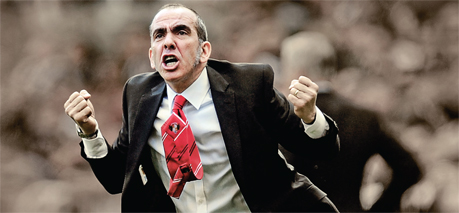
Excitement swirls through Stamford Bridge. As Chelsea and Sunderland line up for kickoff, 41,500 fans eagerly stare down at the visitors’ dugout, where a thin man sporting a vibrant purple-and-grey sweater under a sharp black suit prowls along the sideline. He’s the picture of intensity. It’s been one week since his appointment as Sunderland manager sent Britain into a frenzy, sparking hysteria, protests and a series of fiery press conferences. But today’s his first real test. No matter that Chelsea are the reigning European champions and heavy favourites—today belongs to Paolo Di Canio.
Where to begin with Di Canio? Inspirational and infuriating, brilliant and belligerent. The only real consensus on the 44-year-old Italian is that he’s divisive, equally reviled and revered for living life as a perpetually lit fuse. In a 23-year playing career spanning 10 clubs across three countries, he mesmerized and confused onlookers by combining silky dribbling and jaw-dropping volleys with seemingly endless confrontations with managers, teammates and opponents. He’s a man who followed up an 11-match ban for shoving a referee in 1998 with a FIFA Fair Play award for a remarkable display of sportsmanship three years later. He’s a man who has celebrated goals with a stiff-armed Fascist salute and once decided to tattoo “Dux” (the Latin for“Il Duce,” dictator Benito Mussolini’s title while ruling Italy) onto his right bicep. And, as manager of Swindon Town, he’s a man who gained instant popularity by guiding the club from the depths of League Two to the top of League One, clashing with his players, shovelling snow with fans and compiling a career’s worth of highlight-reel interviews before resigning in protest of the club’s off-field decisions, particularly the sale of his best player, Matt Ritchie. Now, Di Canio is the man tasked with keeping Sunderland from tumbling out of the world’s most popular soccer league.
Stamford Bridge looks on as Di Canio’s debut begins in uncharacteristically muted fashion: The new manager assumes his spot in the technical area, acknowledges the Black Cats fans lustily chanting his name to the tune of “La donna è mobile,” and quietly watches this team’s opening few minutes. But as the game’s rhythm heats up, so too does Di Canio. Soon enough, he’s gesticulating wildly at his players while consistently turning to confer with his assistants behind him. As the final whistle blows (2–1 for Chelsea), Di Canio applauds the supporters still chanting his name, while the reporters race down to the stadium bowels in anticipation.
Anyone who followed Di Canio’s 21-month tenure at Swindon Town knows his press conferences alone are worth the price of admission. The man answers questions the same way he played the game: candidly and passionately, eager to tackle tough queries and unafraid to lambast whomever he pleases. “It wasn’t wise to go in with a list of seven or eight questions, because the way he answered would take 45 minutes,” says BBC Sport’s Gary Rose, formerly of the Swindon Advertiser. “He’d give you real responses, never standard football manager speak.” On good days, the Italian would explain his team’s transformation from chihuahas to Rottweilers, or compare important victories to sex with Madonna—in rockier times, Di Canio would direct his post-match tirades at referees, opponents and even his own players.
Inside the Stamford Bridge press room, the Italian displays his usual exuberance, praising his team’s first-half effort while lamenting the players’ lack of fitness. When a nearby TV screen flashes a replay of relegation rivals Wigan scoring a late goal at QPR, he theatrically slams his fist against the table. But as the uncomfortable political questions resurface, Di Canio’s nerves begin to fray. “How silly you are,” he snaps at a reporter inquiring about his tattoos. As the questions shift from football to fascism, Sunderland’s communications chief, Louise Wanless, decides she’s heard enough—she shuts down the press conference and ushers Di Canio from the room.
It’s been a long week for Wanless, a whirlwind that began the moment Sunderland hired Di Canio on March 31 and ended as she hauled him out of Stamford Bridge. This press conference isn’t the first one she’s cut short, and likely won’t be the last. “It’s been incredibly hectic,” she says. “The local, national, international interest has been constant.” But if Sunderland club executives hadn’t foreseen the controversy that would follow Di Canio’s appointment, it didn’t take long for them to clue in. Within hours of the Italian’s hiring, club vice-chairman—and British Labour Party MP—David Miliband resigned, claiming he could not stay on given Di Canio’s “past political statements.” Miliband was referring, of course, to Di Canio’s ties to the F-word, stemming from his 2000 autobiography, in which he called Mussolini a “deeply misunderstood man,” and in 2005, when he told Italian reporters, “I am a Fascist, not a racist.”
In Sunderland, a city known as a left-wing stronghold, Di Canio’s arrival proved incendiary. Following Miliband’s lead, the Durham Miners’ Association threatened to remove its banners from the Stadium of Light, while many fans renounced their ties to the club in protest. Meanwhile, the rest of the world demanded a response from the new manager.
After a couple of days spent brushing off the political questions, Di Canio issued a statement claiming that he isn’t a Fascist and doesn’t support the ideology of fascism. Good enough for some, unsatisfactory for others, and largely irrelevant for most of the legion of fans who care only about seeing their club avoid relegation from the Premier League (a near death-sentence that would see the club lose not only millions in television and box-office revenue, but virtually every player good enough to find another club in the top league). After all, Sunderland executives appointed Di Canio because they thought he could accomplish what he did with Swindon: inject his unique brand of energy, competitiveness and self-belief into a floundering squad.
The appointment is a risky move: Di Canio has no top-level coaching experience, and his reign at Swindon had its share of turbulence. He’s a harsh disciplinarian, often alienating and publicly shaming players who underperformed or dared challenge his authority (after a spat with goalkeeper Wes Foderingham, he called the 20-year-old the least professional player he’d ever coached), and he clashed repeatedly with board members over money and transfer decisions. He runs his players ragged (Di Canio almost never grants days off), he demands they follow his rules (he once stripped Alan McCormack of the captaincy after the defender missed a training session to go to the doctor) and he absolutely does not tolerate dissent (after striker Leon Clarke clashed with Di Canio, he never played for the Italian again).
Di Canio’s authoritarian style is curious given his own aversion to authority during his playing days—his explosive temperament meant he never lasted anywhere for very long. “He was a great teammate and great motivator, but he had a way about him that you never knew what you were going to get,” says soccer analyst Craig Forrest, who played with Di Canio at West Ham from 1999 to 2002. “If things didn’t go his way, he would challenge the manager, teammates, anyone.”
But he was worth the trouble. Then–West Ham manager Harry Redknapp described Di Canio as “so gifted that other professionals would pay to watch him train.” He knew the price of that talent was having to give the man his space, even if that meant watching the striker throw teacups and Gatorade barrels around the dressing room. “With Paolo, you had to understand what you were dealing with or you’d have problems almost on a daily basis,” says Forrest. “Harry would usually let him do his thing and then sit down and talk sensibly.” The strategy worked: Di Canio still calls Redknapp the best manager he’s played under. Redknapp succeeded because he understood what makes Di Canio tick: an unshakable self-belief, a furious desire to win and an absolute insistence for the team to share that desire.
Today, the Sunderland brass who hired Di Canio will likely try to strike that same balance with their new manager, gambling on Di Canio’s flaws being outweighed by his genius. Di Canio has shown an ability to establish a deep connection with fans and immediately get results from his squad. With a handful of games left, and a razor-thin margin for error, he could be just the man for the job.
In just two games with Sunderland, Di Canio’s already having an impact. After the closer-than-expected loss at Chelsea, Sunderland rebounded with a thrilling 3–0 win away to archrivals Newcastle in the bitter Tyne-Wear derby—the club’s first win at St. James’ Park in 12 years. Sunderland fans looked on in ecstasy as Di Canio vigorously celebrated all three goals—after the second, he ruined his suit pants with an epic knee slide and then maniacally pounded his chest in triumph—before storming the pitch at the final whistle to hug his players and celebrate with the supporters. In the post-game interviews, he called the win the best result of his managerial career to date.
After the victory, which propelled the new manager to near-hero status among club faithful, Sunderland sits three points above the drop zone with five games remaining—still anything but safe, yet buzzing with fresh energy. Di Canio, of course, is ever-confident. Back in the Stamford Bridge press room after his first game and before his first win, he tells the crowd he isn’t worried about relegation. When someone asks him if he really thinks he’ll be able to adjust to the Premier League quickly enough to steer the club to safety, Di Canio responds: “If you are a good manager, like I am, you can change.” A few moments later, he corrects himself. “No,” he says, with a devilish smile. “I’m a very good manager.”